The refund window attaches to this desk
Buying here puts your order with the desk that answers +1 (302) 200-3480 and applies the 60-day window. An order placed somewhere else is somebody else's policy and we cannot help with it.
Metaglucent is a dietary supplement capsule for healthy blood sugar support.
Use case: Adults who want simple daily glucose support take one vegetable capsule a day, from a bottle of 30 capsules.
How it works: Vitamin C, vitamin D, magnesium and chromium are printed with amounts, beside a 528 mg blend of thirteen plant ingredients. The blend amounts are not published.


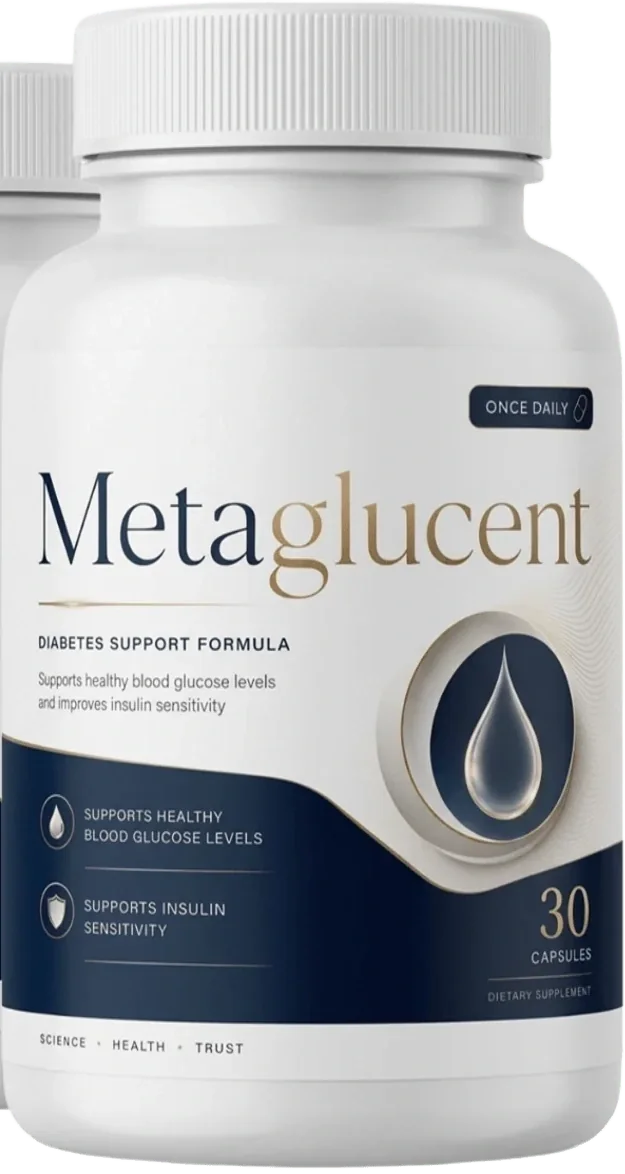


Metaglucent is a dietary supplement sold as a once-daily vegetable capsule, 30 to a bottle. The panel prints amounts for four nutrients and one 528 mg blend of thirteen ingredients. Every pack has a 60-day money-back guarantee from purchase.
Every line below is read off the printed panel, the bottle artwork or the brief we were given. Where we were not given a figure, the row says so instead of guessing.
| Detail | What the label and the seller say |
|---|---|
| Product | Metaglucent, a dietary supplement sold as a once-daily capsule |
| Front of bottle | Metaglucent · Diabetes Support Formula · Supports healthy blood glucose levels and improves insulin sensitivity · Once Daily · 30 Capsules |
| Claims on the front | Four, and not one of them carries an asterisk |
| Form | Vegetable capsules with a hypromellose shell |
| Count | 30 capsules a bottle |
| Serving | One capsule daily. No timing instruction and no direction about food |
| Servings per bottle | 30, one capsule a serving |
| Amounts printed | Four of seventeen dietary ingredients |
| The four | Vitamin C 90 mg · vitamin D 25 µg · magnesium 20 mg · chromium 100 µg |
| The blend | Proprietary Blend, 528 mg, holding thirteen ingredients |
| Percentages | All four correct against the FDA's published Daily Values. We checked |
| Standardisation | None stated for any extract on the label |
| Animal-derived | None on the printed panel. The shell is hypromellose |
| Distributor | Metaglucent, Aurora, CO 80011, USA. No manufacturer named |
| Price | Not published to us. The checkout is the only figure |
| Guarantee | 60 days from purchase unless the sales page prints a longer window |
| Shipping | Ships from the United States. Cost and speed: not published |
| Expiry | Not printed on any label image we were given |
| Order desk | +1 (302) 200-3480, with your order ID |
| Sold by | Themetaglucent, a USA Authorized Metaglucent Retailer |
Metaglucent is a one-a-day capsule aimed at blood sugar. Its back panel prints four nutrient amounts correctly, but thirteen ingredients share one 528 mg number, and the front of the bottle reads Diabetes Support Formula.
Metaglucent is a one-a-day capsule aimed at blood sugar. Its back panel is the most carefully printed we have checked in this series: four nutrients with real amounts, four percentages that all survive the arithmetic, a Latin binomial and a plant part for every botanical, a correctly spelled footnote and a plant-based capsule shell. Then two things undo a good deal of that. Thirteen ingredients — including berberine, gymnema, cinnamon, bitter melon and banaba — share one 528 mg number, so none of them can be matched to a study. And the front of the bottle reads Diabetes Support Formula, which names a disease.
Buy Metaglucent through the Order Now buttons on this website. The price is whatever the checkout prints, because no figure was published to us. Your order is covered by the 60-day money-back window and the order desk.
Ordering here puts your order on the desk that answers +1 (302) 200-3480 and applies the 60-day window to it. Price is whatever the checkout prints; we publish no figure we have not seen.
The front of the Metaglucent bottle reads Diabetes Support Formula, which names a disease. The same label carries the FDA disclaimer. This page puts the question first and prints the regulation instead of judging it.
This is the first thing on this page because it is the most consequential thing on the product, and no amount of good work on the back panel changes it.
Under the wordmark, in capitals, the bottle reads DIABETES SUPPORT FORMULA. Beneath that, in smaller type: supports healthy blood glucose levels and improves insulin sensitivity. Two roundels on the navy band repeat the same two ideas. Along the bottom: Science · Health · Trust.
21 CFR 101.93(g)(1) defines a disease as “damage to an organ, part, structure, or system of the body such that it does not function properly … or a state of health leading to such dysfunctioning”. Paragraph (g)(2) sets out the factors by which FDA judges whether a statement is a disease claim, and the first one on the list is “the name of the product”. Diabetes is a named disease.
The FDA disclaimer is printed on the same label, in its own box, and it says the product is not intended to diagnose, treat, cure or prevent any disease. A disclaimer does not make a disease claim permissible; it is a required footnote to permitted structure and function claims, not a licence for anything else.
There is a second wrinkle. The flat front artwork supplied in the same pack as the Supplement Facts panel carries none of that copy — no Diabetes Support Formula line, no support lines, two blank icon roundels where the bottle images carry text, and a bare gold rule where the disease phrase sits. Whoever produced these files produced two different fronts.
We are a retailer. We do not decide whether a label complies with anything, and we have not pretended to. What we have done is print the regulation, publish both artwork files, and put the whole question at the top of the page rather than at the bottom of a policy link.
Then the appointment matters more than the bottle. Diabetes is managed by a clinician, with monitoring. Nothing on this site is a treatment, nobody should change a prescription because of a capsule, and six ingredients in this formula are studied for pushing blood sugar in the same direction as your medicine.
Metaglucent is a dietary supplement in a hypromellose capsule, 30 capsules to a bottle, taken one a day. The label declares seventeen ingredients: four with printed amounts and thirteen inside one 528 mg proprietary blend.
A dietary supplement in a hypromellose capsule, thirty capsules to a bottle, taken as one capsule a day. The suggested use panel is a single sentence and it adds no condition: no time of day, no instruction about food, no split dose.
Inside each capsule the label declares seventeen dietary ingredients. Four of them — vitamin C, vitamin D, magnesium and chromium — are printed with a weight and a percentage of the Daily Value. The other thirteen are listed by name inside a single Proprietary Blend of 528 mg.
Added together, the four disclosed nutrients come to roughly 110 mg. The blend is 528 mg. So about five sixths of the dietary ingredient in this capsule is described by one number and a dagger.
The other-ingredients line is short and unremarkable: a hypromellose shell, microcrystalline cellulose, magnesium stearate, stearic acid and silicon dioxide. A filler, two anti-stick agents and a flow agent. Nothing animal-derived, which is worth saying out loud in a category built on gelatin.
A single bottle is exactly thirty days of the label's own serving. The guarantee runs sixty days from purchase. That means a first bottle finishes with half the refund window still open — the most forgiving arithmetic of any product we have written up on this desk.
Ordering Metaglucent here puts your order with the desk that answers the order phone line and applies the 60-day window. The label is published in full, and the website email cannot see orders.
Three practical reasons, none of them a claim about the product.
Buying here puts your order with the desk that answers +1 (302) 200-3480 and applies the 60-day window. An order placed somewhere else is somebody else's policy and we cannot help with it.
Our own address, [email protected], handles pages, typos, privacy and press. It cannot see orders. For anything about an order — tracking, a change, a refund — the order desk is the number that works.
Every line of the panel, every one of the thirteen blend names, our recalculation of all four printed percentages, ten things the label does not tell you and seven places our sources disagree with each other. Nothing is behind a link.
Metaglucent prints four amounts: vitamin C 90 mg, vitamin D 25 mcg, magnesium 20 mg and chromium 100 mcg. We checked all four printed Daily Value percentages against the FDA figures, and each one is correct.
Tab through the four nutrients the panel quantifies. Each one shows the printed amount, the printed percentage and what we found when we recalculated it against the FDA's published Daily Value.
One capsule a day. Every amount on this panel is therefore the amount you actually take, with no two-capsule arithmetic and no choice left open by the directions.
Thirty capsules is thirty days. The guarantee runs sixty, which means a single bottle finishes with the refund window still half open.
The Daily Value for vitamin C is 90 mg, so 90 mg is exactly 100%. The printed percentage is right.
Ascorbic acid is the standard form and this is an ordinary, sensible amount. It is not what the front of the bottle is selling.
25 mcg is 1,000 IU. Against the 20 mcg Daily Value that is 125%, and the printed percentage is right.
The tolerable upper intake level is 100 mcg (4,000 IU) a day. One capsule is a quarter of that, which is worth knowing if you already take a separate vitamin D.
20 mg against a 420 mg Daily Value is 4.8%, which rounds to the 5% printed. The arithmetic is right.
The criticism here is not the percentage, it is the amount and the form. The NIH lists magnesium oxide among the least well absorbed forms, and this is one twentieth of a Daily Value of it.
The Daily Value is only 35 mcg, so 100 mcg is 285.7%, which rounds to the 286% printed.
A large percentage here is arithmetic rather than achievement. It is also the line most worth raising with a doctor: the NIH warns that chromium taken with insulin or metformin “might increase the risk of hypoglycemia”.
One number for thirteen ingredients, and more than twice the combined weight of the four nutrients above it.
Under 21 CFR 101.36(c) that is permitted: a blend declares its total weight and lists members in descending order, and individual amounts are not required. The dagger marks that no Daily Value exists for botanicals, which is true and is not why the amounts are missing.
Metaglucent pairs a vitamin and mineral base, including chromium, with a blend of plant ingredients, six of which are studied for blood glucose. The explanation stops at the amounts, because twelve of the thirteen blend ingredients have no published figure.
Four steps, written from the panel rather than from the sales page — we could not read a working sales page at all.
Vitamin C, vitamin D, magnesium and chromium. Chromium is the one with a direct blood sugar story: it is an essential trace mineral, the Daily Value is 35 mcg, and this capsule carries 100 mcg. The other three are ordinary micronutrients at ordinary amounts.
Six of the thirteen — berberine, gymnema, cinnamon, bitter melon, banaba and, on some readings, olive leaf — have been studied for lowering blood glucose. That is clearly the design intent of the blend, and it is also the reason the interaction warnings on this page are as firm as they are.
Turmeric and cocoa lead the blend by weight and are studied mostly for inflammation and vascular function rather than glucose. Eleuthero is an adaptogen. Juniper, pine bark, butcher's broom and guggul each have their own small literatures, none of them about blood sugar in a way that would justify their position here.
At the amounts. Twelve of those thirteen have no published figure, no standardisation and no way to be matched to any trial. A mechanism you can describe is not the same as a dose you can check, and only the four nutrients on this label give you the second thing.
Metaglucent ingredients worth knowing are chromium, vitamin D, magnesium, berberine, gymnema and cinnamon. The first three have printed amounts. The last three sit inside the 528 mg blend, so their amounts are unknown.
Three with printed amounts, three without. Every claim below is sourced to the reference list at the foot of this page.
286% of the Daily Value, and the only mineral here at a meaningful multiple of one. It is also the ingredient the NIH singles out: chromium supplements might have an additive effect with metformin or other antidiabetes medications, and thus might increase the risk of hypoglycemia.
Third by weight in the blend, so its hard ceiling is 176 mg. Sloan Kettering reports that repeated oral berberine significantly decreased CYP2D6, 2C9 and 3A4 activity in human studies, and that the benefit evidence is of limited quality.
Fourth by weight, ceiling 132 mg. One of the older botanicals studied for blood sugar, and one of six ingredients on this panel pointing in the same direction as a diabetes prescription.
Fifth by weight, ceiling about 106 mg. NCCIH notes reported interactions between coumarin, found in cassia cinnamon, and the liver, and says it is unclear whether cinnamon helps with diabetes at all.
1,000 IU, printed as 125% of the Daily Value, which is arithmetically right. Well under the 100 mcg upper intake level on its own — worth adding up if you already take a separate vitamin D.
5% of the Daily Value, in the form the NIH lists as less bioavailable than the aspartate, citrate, lactate and chloride forms. A small amount of the least absorbable common option.
See the full Supplement Facts panel for every line on the label.
The Metaglucent blend holds thirteen ingredients in descending order of weight: turmeric, cocoa, berberine, gymnema, cinnamon, olive leaf, eleuthero, juniper, pine bark, bitter melon, banaba, butcher's broom and guggul. Together they weigh 528 mg.
In the printed order, which under 21 CFR 101.36(c) is descending order of weight. Scroll or use the arrows. Every card says what the ingredient is, where it sits in that order, and what the evidence does and does not support.
Heaviest in the blend
First in the printed order. NCCIH says conventionally formulated turmeric is likely safe for up to two or three months, and that curcumin is poorly absorbed without piperine. There is no piperine on this panel.
No established dose here
Second by weight. Cocoa flavanols have cardiovascular literature at doses far above anything a 528 mg thirteen-way blend could carry, and nothing tying them to blood sugar.
The one to ask about
Third by weight and the ingredient with the most serious interaction profile. Human studies found repeated oral berberine significantly decreased CYP2D6, 2C9 and 3A4 activity — three enzymes that clear a great many prescription medicines.
Studied for blood sugar
Traditional use for blood sugar, with limited modern trial evidence. Like most of this blend, its amount is not published, so no study dose can be compared against it.
Coumarin, and a liver note
Cassia is the coumarin-containing cinnamon. NCCIH notes interactions between coumarin and the liver have been reported, that some cassia products contain high levels, and that prolonged use could be an issue for people with liver disease.
No established dose here
Oleuropein has cardiovascular and metabolic literature. Sixth of thirteen inside an undisclosed blend, so the ceiling is 88 mg and the real figure is unknown.
Adaptogen, not a glucose herb
Sometimes called Siberian ginseng. Studied mainly for fatigue and performance rather than blood sugar, and included here without explanation.
No established dose here
Traditional use as a diuretic and digestive bitter. No modern evidence base for blood glucose that we could find, and no amount published.
No established dose here
Maritime pine bark proanthocyanidins have circulation literature. Ninth of thirteen, so its arithmetic ceiling is 59 mg.
Studied for blood sugar
One of the most-studied traditional blood sugar plants, and NCCIH lists it among supplements studied for diabetes without making an effectiveness claim for it.
Studied for blood sugar
Corosolic acid is the compound of interest and it is studied for glucose uptake. Eleventh of thirteen, so its ceiling is 48 mg.
No established dose here
A circulation herb, normally sold for vein and leg symptoms. Twelfth of thirteen and the least explicable inclusion on a glucose label.
Lightest in the blend
Last in the printed order, so the smallest weight of all thirteen. Its ceiling is 41 mg and the real amount will be at or under that.
The four printed Metaglucent amounts come to roughly 110 mg, against a 528 mg blend. Chromium reaches 286% of the Daily Value because that Daily Value is only 35 mcg, which is arithmetic rather than achievement.
Four bars, one per nutrient, against the FDA Daily Value. The blend has no bar because it has no number to draw.
Percent of the Daily Value, as printed100% = one full Daily Valueper one-capsule serving
The proprietary blend is more than twice the combined weight of the four nutrients above, and it holds thirteen ingredients with no individual amount for any of them. It cannot be drawn on this axis or any other, because nothing has been published to draw. Turmeric weighs the most and guggul the least; that is the whole of what the label says about 528 of the 638 milligrams in the capsule.
Because the blend is listed in descending order, each ingredient cannot weigh more than 528 mg divided by its position. Turmeric could be at most 528 mg and guggul at most 41 mg. These are upper bounds, not amounts.
Descending order of weight means the ingredient in position n cannot be more than the 528 mg total divided by n. These are hard upper bounds, not amounts. Every one of them is equally consistent with a trace.
| # | Ingredient as printed | Cannot exceed |
|---|---|---|
| 1 | Turmeric (Curcuma longa) Rhizome | 528 mg |
| 2 | Cocoa (Theobroma cacao) Bean Extract | 264 mg |
| 3 | Berberine HCL | 176 mg |
| 4 | Gymnema (Gymnema sylvestre) Leaf | 132 mg |
| 5 | Cinnamon (Cinnamomum cassia) Bark | 106 mg |
| 6 | Olive (Olea europaea L.) Leaf Extract | 88 mg |
| 7 | Eleuthero (Eleutherococcus senticosus) Root Extract | 75 mg |
| 8 | Juniper (Juniperus communis) Berry | 66 mg |
| 9 | Pine (Pinus pinaster) Bark Extract | 59 mg |
| 10 | Bitter Melon (Momordica charantia) Fruit Extract | 53 mg |
| 11 | Banaba (Lagerstremia speciosa) Leaf Extract | 48 mg |
| 12 | Butcher's Broom (Ruscus aculeatus) Root Extract | 44 mg |
| 13 | Guggul (Commiphora mukul) Resin Extract | 41 mg |
Read the last column honestly: it is the most each could be, on the assumption that everything below it in the list is vanishingly small. In a thirteen-ingredient blend that assumption cannot hold for more than one or two of them at a time.
The annotated Metaglucent label has eleven markers across three panels, covering suggested use, the caution, the FDA disclaimer, the distributor, the four nutrients and the blend. Tap a marker to see what each line says and leaves out.
Eleven markers across the three panels the pack supplied. Tap one to read what that line says, and what it leaves out.

Swipe the label sideways to reach every marker.
Tap a numbered marker on the panel to read what that line actually says, and what it does not.
The Metaglucent Supplement Facts panel lists a serving size of one capsule, 30 servings per container, four nutrients with amounts and percentages, and one 528 mg proprietary blend. The label shown is from lot MET-26/TH-3375.
The Metaglucent marketing panel names six ingredients, but the printed Supplement Facts panel lists seventeen. The eleven missing from the marketing include berberine, cinnamon and bitter melon. This site follows the label, not the marketing.
The brief we were given names six ingredients: vitamin C, vitamin D, magnesium, chromium, turmeric and gymnema. The listing's ingredients panel shows the same six. The printed Supplement Facts panel has seventeen.
The eleven that do not appear in the marketing are cocoa, berberine, cinnamon, olive leaf, eleuthero, juniper, pine bark, bitter melon, banaba, butcher's broom and guggul. Among them are three of the ingredients most likely to interact with a prescription: berberine, cinnamon and bitter melon.
That is not unusual and it is not, on its own, dishonest — a marketing panel is allowed to be a selection. It matters here because the ones left out are the ones a pharmacist would want to know about, and because the six that are shown are the four with printed amounts plus the two best-known botanicals.
We follow the panel throughout this site. Where the brief and the label disagree, the label wins, and the disagreement gets printed rather than quietly resolved.
The label beats the brief, every time. Seven conflicts between our sources are listed further down this page, with both versions side by side.

The Metaglucent pack makes a short list of claims: Diabetes Support Formula, supports healthy blood glucose levels, improves insulin sensitivity, Science Health Trust, Doctor Formulated and Once Daily. Only Once Daily is easy to verify.
On most products in this aisle these panels carry the benefit claims that the Supplement Facts box cannot support: energy, stamina, vitality, confidence, each with an asterisk. They are where a label goes to promise things.
Both of this brand’s panels decline to. They are navigation, pointing back at the formula, the facts panel, the directions and the format. The recurring instruction across both is Follow Label Directions.
That leaves the entire promise of this product resting on two words printed on the front of the bottle, which is what the cards below are about.
Printed on the front of the bottle, directly under the brand name. Diabetes is a disease, and 21 CFR 101.93(g)(2) lists the name of the product among the factors by which FDA judges a disease claim. The FDA disclaimer appears on the pack, and a disclaimer does not make a disease claim permissible. This is the most serious labelling question we have raised on any site on this desk.
Taken alone this is an ordinary structure and function claim, of the kind a supplement may make with the disclaimer attached. It is the company it keeps on this pack that changes how it reads.
“Improves” is a stronger verb than “supports”, and insulin sensitivity is a clinical measure rather than a feeling. Nothing on the panel is presented with a dose that could be matched to a trial measuring it.
Three words on the front of the bottle with nothing behind them that we can check. No study is cited on the pack, no laboratory is named, and no certificate was published to us.
A badge on the listing. No doctor is named on the label, on the listing, or anywhere in the material we were given. We have not invented one, and a credential you cannot check is not a credential.
Printed in a roundel on the front, and completely true. One capsule a day is exactly what the suggested use panel says, and it is the easiest claim on the pack to verify.
The evidence behind Metaglucent ingredients is modest. Chromium lowered glucose slightly in some studies with unclear significance, vitamin C and magnesium are ordinary nutrients, and berberine studies are of limited quality. Blend amounts are unpublished, so no dose can be matched to a study.
Front of the card: what it is and where it sits on the label. Tap it over for what a named, checkable source says. Every source here is one we opened.
Metaglucent pros: four correct Daily Values, a vegetarian hypromellose capsule and one capsule a day. Cons: the front names a disease, thirteen ingredients share one 528 mg number, no price is published and there are no verified reviews.
Both columns are longer than usual, because this is a genuinely split product.
Metaglucent may suit vegetarians who want one capsule a day and a label they can read. Skip it if you take metformin, a sulfonylurea, insulin or other prescriptions, have liver disease, or are under 18, pregnant or nursing.
The simplest regimen of any product we have written up. One capsule, no timing instruction, no split dose, no loading phase.
Vitamin C, vitamin D, magnesium and chromium all carry an amount and a percentage, and we checked all four against the FDA's published Daily Values. All four are right.
The capsule shell is hypromellose, a plant material, and nothing in the other-ingredients line is animal-derived. That is unusual in this category.
One bottle is thirty days, so a single bottle finishes with half the refund window still to run. That is the most buyer-friendly arithmetic of any product on this desk.
This label rewards that habit. The panel is specific, the percentages are correct and the species are named.
Thirteen ingredients share 528 mg. We publish the hard ceiling for every position in that order, which is the one thing the label will not do for you.
This is the firmest line on the site. The NIH warns that chromium with insulin or metformin might increase the risk of hypoglycaemia, and five more ingredients in this blend are studied for lowering blood sugar. Talk to the clinician who manages your diabetes first.
Berberine, third by weight in the blend, significantly decreased CYP2D6, 2C9 and 3A4 activity in human studies. Those enzymes clear a great many common medicines.
The blend contains cassia cinnamon, and NCCIH notes that prolonged use could be an issue for sensitive people such as those with liver disease.
You can check four of them. You cannot check the other thirteen, and they are 528 of the 638 milligrams in the capsule.
The bottle says so outright, and berberine carries a specific caution about infants.
It is not one, and no dietary supplement may lawfully claim to treat a disease. Diabetes is managed by a clinician, with monitoring, and nothing sold on this site changes that.
These five questions check age, pregnancy, blood sugar medicine, other prescriptions and liver disease before you buy Metaglucent. Nothing you answer leaves your browser, because there is no form and nothing is sent anywhere.
Nothing you answer leaves your browser — there is no form here and nothing is sent anywhere. Answer honestly; a single yes on the first two ends the quiz for a reason.
0 of 5 answered
Take one Metaglucent capsule a day, as the suggested use panel says. The label gives no time of day and no instruction about food, so pick a fixed time. Do not exceed the dose, and store it in a cool dry place.
Straight from the suggested use and caution panels. Where the label is silent, this page says so rather than filling the gap.
The panel reads: as a dietary supplement, take one (1) capsule daily. That is the entire instruction. There is no second serving and no maintenance dose.
The label gives no time of day and no instruction about food, so we will not invent one. What matters for a once-daily capsule is consistency, so attach it to something you already do every day at a fixed time.
The caution panel says not to exceed the recommended dose. With a blend whose contents have no published amounts, doubling means doubling something you cannot measure.
Store this product in a cool dry place below 30°C, which is 86°F. Keep out of reach of children. Do not use if the safety seal is damaged or missing.
Before the first capsule, not after the first month. NCCIH's guidance is direct: people who take diabetes drugs should tell their health care providers about any herbal supplements they are taking. Take a photograph of the panel to the appointment.
At one capsule a day, one Metaglucent bottle lasts 30 days, two bottles 60 days, three bottles 90 days and six bottles 180 days. Only one or two bottles finish inside the 60-day guarantee window.
Pick a pack size. The arithmetic is done at one capsule a day against a 60-day guarantee, which is the only pair of numbers on this page we can confirm.
One Metaglucent bottle is 30 capsules, so it is empty on day 30. The 60-day guarantee still has 30 days left to run at that point, which makes a first bottle the most forgiving way to try it.
Thirty capsules, thirty days. The point of the picture is the third key below: when the bottle is empty, the refund window is only half spent.
One capsule, one dayDay 30, the bottle is emptyThe 60-day guarantee still has 30 days left to run
Against the category, Metaglucent prints four nutrient amounts with correct percentages, names every botanical by Latin name and uses a plant-based capsule. It loses on the one row that matters most: its front-of-pack claim names a disease.
Six rows. The comparison is with the shelf, not with a named competitor, and it cuts both ways.
| What we look at | Metaglucent | The category norm |
|---|---|---|
| Nutrients with a printed amount | Four, all with correct percentages | Often none; everything hidden in one or two blends |
| Blend disclosure | One 528 mg blend over thirteen ingredients | One blend over six to twelve is typical |
| Botanical naming | Binomial and plant part for all thirteen | Common names only, frequently with no plant part |
| Capsule shell | Hypromellose, plant-derived | Gelatin, in most of what we have read |
| Standardisation | None stated | None stated |
| Front-of-pack claim | Names a disease | Vague structure and function wording |
Four of those six rows are in this product's favour. The fifth is a tie. The sixth is the one that matters most, and it is the one it loses.
Metaglucent comes in packs of 1, 2, 3 or 6 bottles, each bottle holding 30 capsules. Every pack card says price at checkout. If you have never taken it, this desk advises starting with one bottle.


No price was published to us. We print no figure we have not seen ourselves. · Returns run on the listing’s window, not a seller guarantee · What that actually means
There is no price on this page because none was published to us, and this desk prints no figure it has not seen. The checkout shows the real price before you pay, and one bottle is 30 capsules.
Because no price was published to us. The brief is explicit that pack prices are the ones printed on the info page at checkout, and it prints no figure of its own. We did not find a working sales page to read one from — the brief records the sales page title as a Portuguese 404 error.
So every pack card above says price at checkout, and none of them carries a number. We would rather publish a gap than a guess, because a wrong price on a review site is a worse failure than a missing one.
What we can tell you is the arithmetic that does not depend on price. One bottle is thirty capsules and thirty days. Two bottles land exactly on day sixty, which is the last day of the guarantee. Three and six bottles run past it, so the money is committed before the window closes.
That is the whole basis for our advice on pack size, and it holds at any price the checkout shows you. If you have never taken this product, buy one bottle.
Whatever the checkout prints is the price. Read it there, and keep the order email — it is what the refund desk will ask for.
Metaglucent is not for anyone under 18, pregnant or nursing. The NIH warns chromium might add to the effect of metformin or other diabetes drugs, and berberine reduced the activity of enzymes that clear many medicines. Ask your clinician first.
Everything here is sourced. Nothing here is medical advice, and none of it replaces the clinician who manages your health.
Start with the label's own words: consult with a physician prior to use especially if you are taking a medication or have a medical condition. On most supplements that sentence is boilerplate. On this one it is the operative instruction, because the product is aimed squarely at people who are already taking medication for a medical condition.
The NIH Office of Dietary Supplements states that chromium supplements “might have an additive effect with metformin or other antidiabetes medications and thus might increase the risk of hypoglycemia”. This capsule carries 100 mcg of chromium, 286% of the Daily Value.
Then count the blend. Berberine, gymnema, cinnamon, bitter melon and banaba have all been studied for lowering blood glucose. With chromium that is six ingredients pointing the same direction in one capsule — and five of the six have no published amount, so nobody can say how hard they push.
Berberine carries a second, separate concern. Memorial Sloan Kettering reports that repeated oral berberine significantly decreased CYP2D6, 2C9 and 3A4 activity in human studies. Those three enzyme systems clear a very long list of ordinary prescription medicines, and the interaction is not limited to diabetes drugs.
NCCIH adds a liver note about the cassia cinnamon here: interactions between coumarin, a chemical found in cassia cinnamon, and the liver have been reported. With no amount printed, the daily coumarin exposure from this capsule is unknowable.
And the label's own exclusions: not for anyone under 18, not for pregnant or nursing mothers, do not exceed the recommended dose.
Ask the clinician who manages your diabetes before you buy, not after. That is the firmest sentence on this website, and it is the one we would keep if we had to delete every other line.
No Metaglucent timeline has been published, and this site will not invent one. One bottle lasts 30 days at one capsule a day, and day 60 is the last day of the refund window, the natural decision point.
This table is mostly empty on purpose. No timeline was published to us, and we do not invent them.
| When | What the label or the brief says | What we can actually confirm |
|---|---|---|
| Day 1 | One capsule, any time of day | The serving, and that it is the whole instruction |
| Week 1 | Not published | Nothing. The brief's week-one line comes from the review block it marks as layout copy |
| Week 2 | Not published | Nothing |
| Week 4 | Not published | Day 30: the bottle is empty and the guarantee has 30 days left |
| Weeks 4–8 | The brief's “most wait” figure | Not evidence. It is drawn from the same layout-copy block |
| Day 60 | — | The last day of the refund window. The decision point, whatever you have noticed |
Be careful with any blood sugar supplement if you already take medicine for it, because the risk is what happens if the supplement works on top of the drug. Proprietary blends make this harder, since the amounts cannot be checked.
Not about this product specifically. It is the context that makes the questions above worth asking of any bottle in this aisle.
This is the one supplement category where the buyer is, by design, already on medication. That inverts the usual risk calculation. For most supplements the question is whether an ingredient does anything; here the more useful question is what happens if it does, on top of a drug that is already doing it.
The FDA has for years published warnings about products in the diabetes and blood sugar space found to contain undeclared pharmaceutical ingredients — in some cases the same prescription drugs the buyer may already be taking. We have no evidence of anything of the sort here and we are not implying any; the category history is simply the reason a label that discloses amounts is worth more here than almost anywhere else.
Proprietary blends make that worse rather than better. A blend is legal under 21 CFR 101.36(c) and it is the single most common reason a supplement cannot be evaluated. When the blend is 528 of 638 mg, an evaluation is not really available to anyone outside the company.
The last one is about the word “support”. It carries no defined threshold. A product may support healthy blood glucose levels at any dose of anything, because nobody has specified what supporting means or what would count as failing to. That is not an accusation against this brand; it is how the vocabulary of the whole category works.
The practical answer to all of it is the same and it is dull: read the panel, count what has an amount, take a photograph of it to whoever prescribes for you, and keep the receipt.
Buy Metaglucent on this website, a USA Authorized Metaglucent Retailer. An order placed here is the one the 60-day window applies to. This desk cannot see, refund or trace a marketplace order or a link from an email.
This desk, themetaglucent.com, is a USA Authorized Metaglucent Retailer. An order placed here is the one the 60-day window applies to and the one +1 (302) 200-3480 can look up.
We cannot see a marketplace order, cannot refund it and cannot tell you where the bottle came from. Storage and handling in a third-party chain are nobody's documented responsibility.
If a message offers this product at a price, check it against the checkout here before you enter a card. We do not send price emails and we never paste tracking links into our pages.
There are no verified Metaglucent reviews on this site. The material supplied includes a review block that its own source note calls layout copy only, so no star score, order count or named buyer is shown.
The material supplied with Metaglucent does contain a review block: a star score, a count of written reviews, a count of orders, a recommendation percentage and eight named buyers with ages, cities, pack sizes and day counts.
Its own source note says, in as many words, that the reviews, star scores and order counts in that pack are layout copy only — placeholder content for designing a page, not feedback from people who bought this product.
So we do not print it. Not as reviews, not as a rating in the header, not as an order count, and not as a “% would recommend” figure. Publishing invented testimonials is the one thing this desk will not do, whatever it costs in conversion.
Individual experiences, collected after purchase, attributable to an order, and published unedited including the bad ones. Where we have had one on this desk, we have printed it in full and said who supplied it.
A number with no verifiable set behind it is decoration. Any site can print 4.7 out of 5. What you can check is the label, and the label pages on this site are where the evidence actually is.
Write to [email protected]. We will publish what people actually send us, good and bad, marked as unverified, and we will say how many we have. Until then this page stays as it is.
The complaints Metaglucent would attract are that you cannot tell if it works, that the blend is most of the capsule, and that the front says diabetes. All three are fair, and the label invites them.
With no verified buyer feedback to quote, the honest thing is to say plainly which criticisms the label itself invites.
Very likely, and the label gives you no way to settle it. There is no outcome named, no timeline published and no dose you could compare against a study. For anything involving blood sugar, the measurement belongs to your clinician and not to a website.
Correct, and it is the structural criticism of this product. 528 of 638 mg is described by one figure. It is legal, it is common, and it is why we score dose against research at 2 out of 5.
Also correct, and it is the first thing on this page for that reason. Whatever the back panel gets right, the front names a disease, and a disclaimer elsewhere on the pack does not undo that.
Metaglucent has a 60-day money-back guarantee from purchase, unless the sales page prints a longer window. Call the order desk with your order ID before posting anything, and pay return shipping yourself. Refunds are credited in 3 to 5 business days.
Sixty days from purchase unless the sales page prints a longer window. It is a purchase policy, not a promise about results.
It carries the order ID, and the order ID is the first thing the desk will ask for. It is also where the tracking number lives.
Start the claim on the phone with your order ID. Do not send a parcel back unannounced — an unexpected return is harder to match to an order.
Full name, the email address on the order, and the order ID, written on a sheet inside the parcel.
To 546 Fifth Avenue, Floor 6, New York, NY 10036. Return shipping is paid by the buyer. Keep the tracking number until the refund lands.
Three to five business days for the desk to credit it once the return is processed, then five to ten days for the money to appear on the card. They add up, so count from the second one.
This desk scores Metaglucent 2.8 out of 5. It earns 5 for percentage accuracy and ease of use, and 1 for claim honesty and buyer feedback, because the front names a disease and no verified reviews exist.
The most contradictory label in this series. The back of the bottle is the best we have checked: four nutrients with real amounts, four printed percentages that all survive the arithmetic, a vegetarian capsule and a clear caution panel. Then the front says Diabetes Support Formula, which names a disease, and the panel hides thirteen ingredients inside one 528 mg number — including berberine, gymnema, cinnamon, bitter melon and banaba, five things studied for pushing blood sugar down, sold to people who may already be taking medicine that does the same thing. The care that went into the percentages did not reach the front of the pack or the blend. If your blood sugar is the reason you are here, the first purchase worth making is an appointment, not a bottle.

Every page, every journal post, the bottle facts and the ingredients go through review by Dr. Gerti Tashko, MD before they ship. Written and reviewed by the Themetaglucent Editorial Desk. Themetaglucent is the USA Authorized Metaglucent Retailer, operating from 299 Park Avenue, Floor 21, New York, NY 10171, USA. We are an organisation rather than a named individual, and we have not invented a doctor, a reviewer or a credential to put at the top of these pages.
Everything here is read off the printed label. Where a fact was not published to us, the page says not published. Every study we cite is one we opened and read, including the ones that found nothing. A correction moves the last-updated date forward.
We earn when you buy through this site. That is why the missing price, the unquantified blend and an editorial score of 2.4 out of 5 are all published here.
Last updated October 26, 2026 · Our full method · Report a correction
The sources are US regulations, NIH and NCCIH fact sheets, Memorial Sloan Kettering herb monographs and FDA guidance. Every one was opened and read, including the studies that found nothing.
Every source above was opened and read. Studies that found nothing are included on purpose.
These are the questions people ask about Metaglucent: what it is, why the front says Diabetes Support Formula, what is in the blend, how to take it, price, reviews and the guarantee. Answers follow the printed label.
Metaglucent is a dietary supplement in vegetable capsules, thirty to a bottle, taken as one capsule a day. The panel declares four nutrients with amounts, then one Proprietary Blend of 528 mg holding thirteen more ingredients with no individual amounts.
Metaglucent has vitamin C 90 mg, vitamin D 25 mcg, magnesium 20 mg and chromium 100 mcg, plus a 528 mg blend of turmeric, cocoa, berberine, gymnema, cinnamon, olive leaf, eleuthero, juniper, pine bark, bitter melon, banaba, butcher's broom and guggul.
One capsule a day. The suggested use panel reads: as a dietary supplement, take one capsule daily. There is no instruction about food or time of day, and the caution panel adds: do not exceed recommended dose.
The label tells you to consult a physician before use, especially if you take medication or have a medical condition. The main concerns are low blood sugar with diabetes drugs, medicine interactions from berberine, and a liver note on cassia cinnamon.
Ask the clinician who manages your diabetes before you buy, not after. The NIH states that chromium supplements might add to the effect of metformin or other antidiabetes medications, and five more ingredients in this blend are studied for lowering blood sugar.
Metaglucent is not for anyone under 18, or for pregnant or nursing mothers. Skip it or ask a clinician first if you take metformin, a sulfonylurea, insulin or any other prescription medicine, or if you have liver disease.
No. Dietary supplements are not approved by the FDA before they are sold, and Metaglucent is sold as a dietary supplement. The pack carries the standard FDA disclaimer, and a seal about an FDA-registered facility is not the same as approval.
No timeline is published, and this site will not invent one. One bottle is thirty capsules, so thirty days at one a day. The guarantee runs sixty days, so a first bottle finishes with half the refund window still open.
Buy Metaglucent through the Order Now buttons on this official website. The price was not published to us, so every pack card says price at checkout, and the checkout shows the price before you pay.
Sixty days from purchase, unless the sales page prints a longer window. Call the order desk with your order ID to start a claim. It is a purchase policy, not a medical promise: it returns your money and does not imply anything about results.
There are no verified Metaglucent reviews on this site yet. No review we were given could be matched to a real buyer, so we show no star scores, order counts or named buyers. The reviews page explains the gap.
Metaglucent is a real, labelled dietary supplement: thirty vegetable capsules a bottle, four nutrients printed with amounts and a 528 mg proprietary blend. Every pack comes with a sixty-day money-back guarantee. That guarantee returns your money; it is not a promise of results.
One Metaglucent bottle is 30 capsules, enough for thirty days at one a day, and it finishes with half the 60-day guarantee still to run. The price is shown at checkout, and the pack is not for under 18s, pregnancy or nursing.
One bottle is 30 capsules: thirty days at one a day, finishing with half the 60-day guarantee still to run. The price is shown at checkout.
Order NowRead the label firstNo price was published to us. We print no figure we have not seen ourselves. · 60-day guarantee from purchase · Not for under 18, pregnancy or nursing